
IW Hockey is here to ensure you have all the information you need to make the right purchase for your game. Whether you are looking for help choosing the perfect size, selecting the appropriate level gear, or improving your skills, IW Hockey has the tools you need.
How to find your Hockey Skate Size at Home
There are two methods you can use to find your hockey skate size at home. The first method is the quickest; all you need to know if your shoe size but preferably dress shoe size since they tend to be more accurate. The second method is a bit more advanced and accurate since it requires you to trace and measure your feet.
Method #1:
Generally speaking, senior hockey skates fit 1.5 sizes down from a men's shoe size while junior and youth hockey skates fit 1.0 size down from a boy's shoe size. For example, a player wearing a size 8.0 men's shoe size would select a senior size 6.5 hockey skate. For junior or youth players who have quickly growing feet, selecting a skate only ½ size down is an option to allow for extra room for growth.Keep in mind hockey skates sizes vary between manufacturers so it is important to always check each product page for that specific skate's sizing information. Generally speaking, a vast majority of players should fit well in a Medium Volume Fitting skate in the Standard D, R or E width.
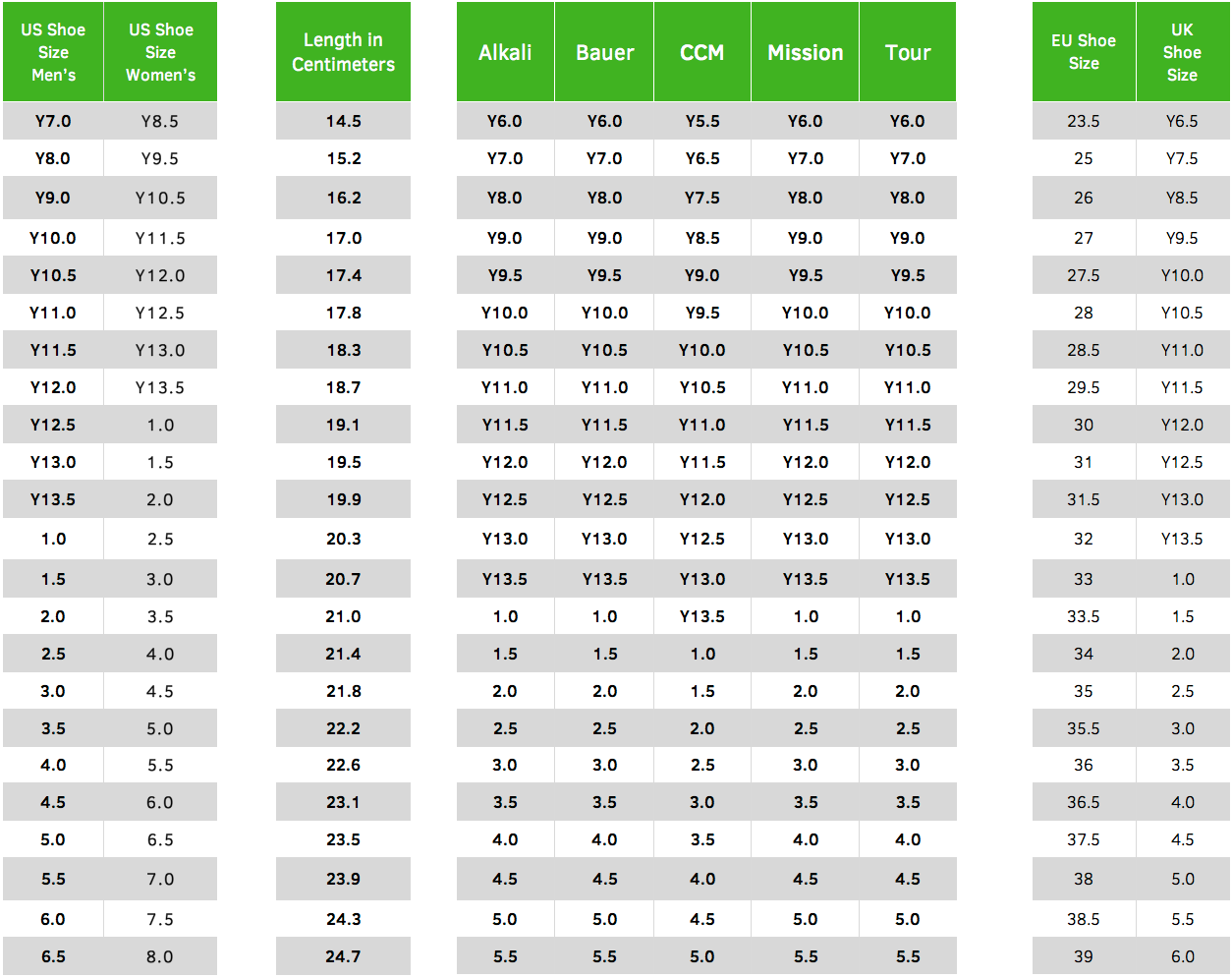
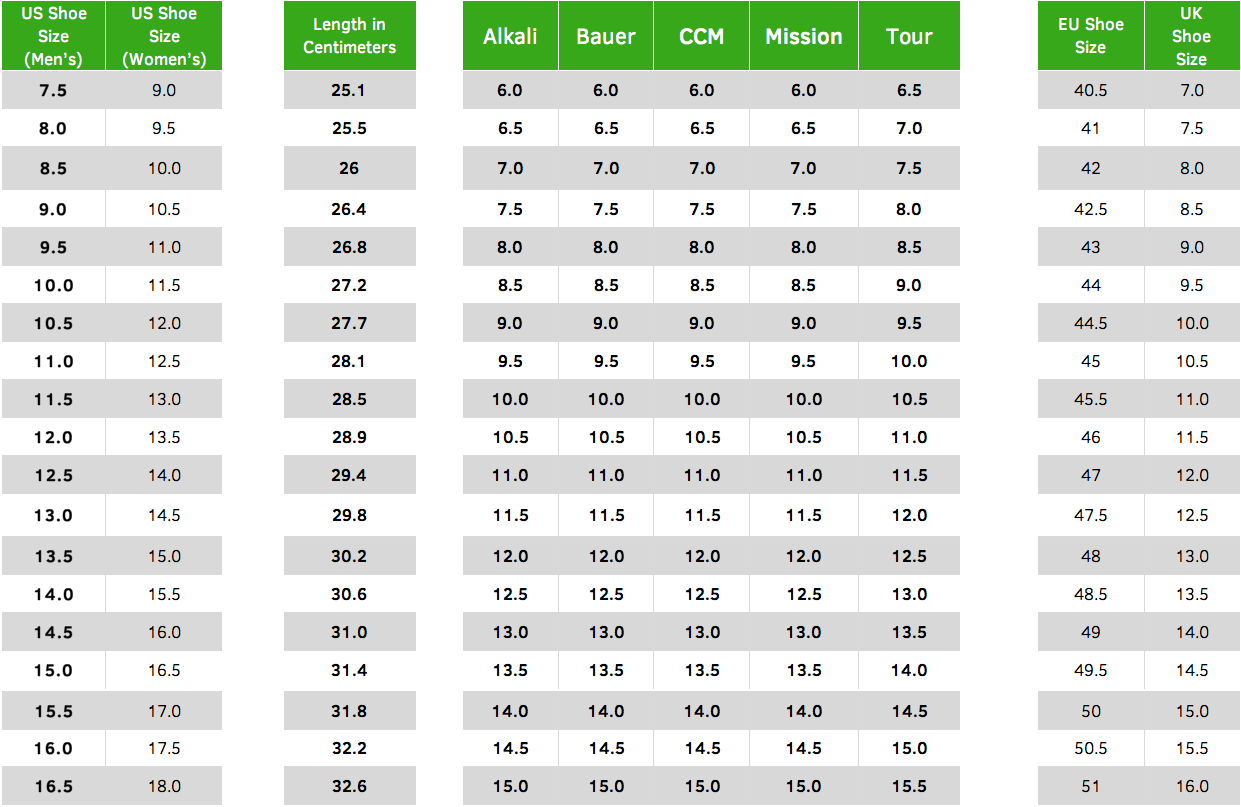
Note: Sizing is a preference and therefore charts DO NOT GUARANTEE FIT. Do not heat, bake, sharpen or skate until you are sure you will not need to return or exchange.
Method #2 - Foot Tracing:
This is a more advanced and accurate way of finding out your skate size not just in terms of length but width and fit type too. All you will need to get started is a hard surface to stand on, a blank piece of paper, a pen/pencil and a tape measurer or ruler.- 1. Place the paper on a hard surface.
- 2. If you wear skate socks, put them on now and then step onto the paper so that your entire foot fits on it with spare room around the entire foot.
- 3. While standing, take the pen or pencil and begin tracing. Keep whatever you are using to trace perpendicular to the paper while you outline your foot. By keeping your pen or pencil perpendicular, it prevents you from measuring underneath your foot, which would give you an inaccurate foot outline.
- 4. Step off of the paper and measure in centimeters, the distance from the furthest point of your toes to the end of the heel. This will be your foot length measurement. Now measure the widest point of your forefoot, this is your foot width measurement.
- 5. Repeat Steps 1-4 for your other foot. This can be done on either the backside of the paper that was just used or you can use a new, blank piece.
- 6. Take your Left Foot Length Measurement and divide it by your Left Foot Width Measurement, this is your Left Foot Width Ratio. Repeat this step for your right foot to get your Right Foot Width Ratio.
Length:
Now that we have your length measurements, width measurements and your width ratio for both feet, it is time to find your skate size. Use the longest length measurement of the two and compare it to the "Length in Centimeters" column in the hockey skate size charts above. If your foot length is longer than 25.1cm, use the Senior chart. For foot lengths 24.7cm or shorter, use the Junior & Youth chart.Foot Width & Skate Fit Type:
Now that we know your skate size, we need to find the right skate fit type to match the width and depth of your foot using your width ratio. This number, length divided by width, indicates how wide your foot is compared to how long it is. Use the chart below to find the correct fit type for your foot width.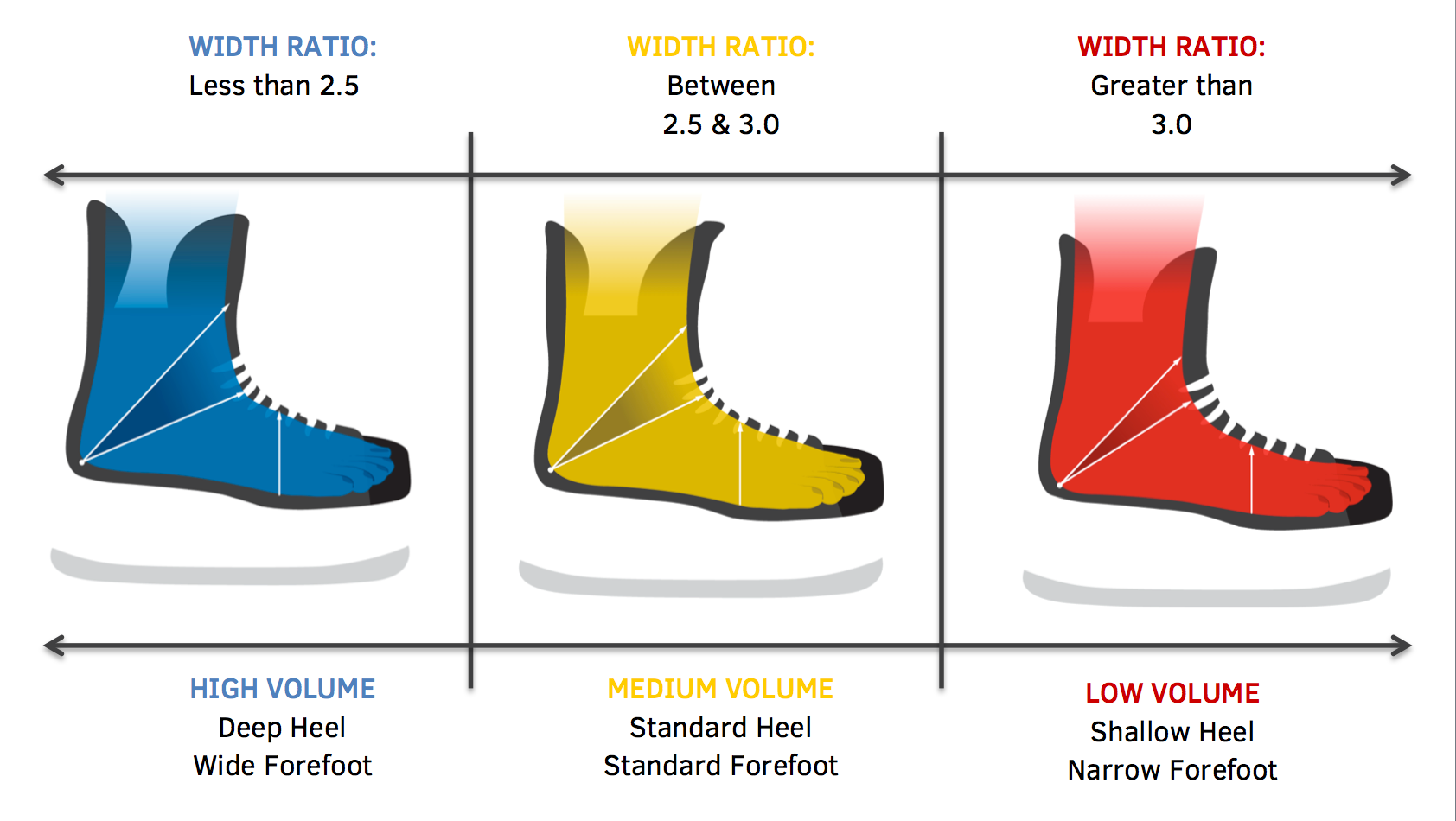
If your width ratio is less than 2.5, you are in the High Volume category because you have a wide foot. If your width ratio is between 2.5 and 3.0, you are a Medium Volume fit with a standard width foot. If your width ratio is greater than 3.0, you should look at Low Volume skates to fit your narrow foot.
For players that have a width ratio just slightly less than 3.0 but technically fall in the Medium Volume category, you can get a Low Volume skate in the EE width to help accommodate your foot. Players that have a width ratio just slightly less than 2.5 but technically fall in the High Volume category; you can get a Medium Volume skate in the EE width to help accommodate your foot too!
If your width ratio is between 2.5 and 3.0, you have a fairly standard foot width and should look for a Medium Volume fit type. If your width ratio number is closer to 2.5, you have a slightly wider foot and may want to go with an EE skate width in a Medium Volume skate. If your width ratio number is closer to 3.0, you have a slightly narrower foot and may wish to go with a Low Volume skate in EE width. While a majority of standard fitting skates should suit you, in-step height is another area to consider when purchasing skates. If you know you have a high in-step or if you have been prone to lace-bite in the past; going with a High Volume skate or an EE-width Medium Width skate may be your best choice.
If your width ratio is less than 2.5, you have a wider foot and should select a High Volume skate for optimal fit; which can be accomplished one of two ways. If your width ratio is near 2.5, you may be able to get a Medium Volume skate in the EE width or a High Volume skate in a D width.
If your width ratio is larger than 3.0, than a narrow fitting skate should fit you best. These are less common than Standard or Wide foot types but typically fit in low-volume, narrow-fitting skates. If your number is near 3.0, a standard fitting D skate could work as well but the larger the width ratio number, the more narrow of a skate you will want to select.
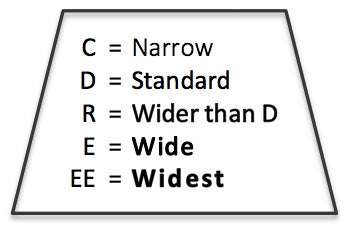
D and EE width sizes are the most common in the hockey market, with D representing the standard width for a given skate line and EE representing a 3/16" wider size compared to D. The important thing to remember is that skate manufacturers will use these two width sizes (plus a handful of others listed below) in all of their skate families, which themselves vary in width within a manufacturer. Bauer for example has Vapor, Supreme and Nexus Skate Lines that represent Narrow, Standard and Wide fitting skate lines respectively but all are available within D and EE widths. The D and EE width skates bridge the gap between Narrow to Standard and Standard to Wide, providing consumers with plenty of options to choose from.


