Overview
Playing Style
-
Power-Focused Playing Style
This style suits players who thrive on generation strong, top end speed through longer and forceful strides. They come with a stiffer boot that efficiently transfers energy into the rink for maximum power with every stride.Acceleration-Focused Playing Style
For players who rely on quick bursts of speed and agile movements to dominate the game, this type of skate is ideal. These offer a moderately stiff boot that balances support with mobility. These these skates, you can swiftly change direction, make sudden moves and accelerate rapidly.
Fit Profile
-
If multiple categories are selected, it indicates the skate is available in or can be molded to different fit profiles.
Low Profile Fit
Narrow forefoot, narrow heel pocket, shallow instep depth and low overall volume.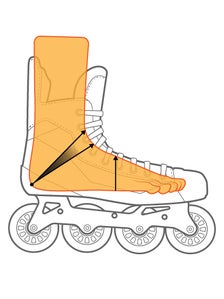
Medium Profile Fit
Medium forefoot, medium heel pocket, medium instep depth and medium overall volume.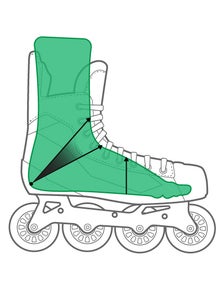
Shop All Medium Profile Skates
High Volume Fit
Wide forefoot, wide heel pocket, deep instep depth and high overall volume.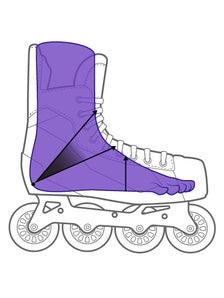
Level of Play Definitions
-
If multiple categories are selected, it indicates the skate is suitable for multiple levels of play.
Recreational-Level Skates
Built for the new-to-hockey player or casual skaters that are looking for an affordable option. These are great starter skates, especially for youth players.
Shop All Recreational Skates.Performance-Level Skates
Designed for players who are confident in their skating stride and are ready to take their performance to the next level. These players are on the rink 1-2 times a week playing mid-to-high level hockey.
Shop All Performance Skates.Elite-Level Skates
Engineered for the best performance, protection, durability and comfort. These players are usually on the rink three times or more a week and are playing high-level hockey.
Shop All Elite Skates.
Cut Protection Level
-
This is the general level of protection against cuts.
- Minimum: Basic protection suitable for competitive play
- Standard: Balanced protection for intense gameplay. Protects against more severe cuts.
- Maximum: Highest level of cut resistance for elite gameplay. Ideal for competitive adult hockey and designed for the biggest and fastest players.
ANSI Rated Cut Level
-
Measures the actual cut resistance of materials based on the ANSI/ISEA 105 standard.
ANSI Level Description Grams of Force N/A No specific cut resistance rating provided by the manufacturer. N/A A1 Minimal protection; withstands light cuts. 200-499 A2 Lower-level protection; resists slightly heavier cuts. 500-999 A3 Low-level protection; suitable for competitive play. 1,000-1,499 A4 Standard protection; defends against significant cuts. 1,500-2,199 A5 Elevated protection for intense play. 2,200-2,999 A6 Extra protection for faster, higher-impact play. 3,000-3,999 A7 Ultra-high protection. 4,000-4,999 A8 Premium protection for all levels of play and ages. 5,000-5,999 A9 Top-tier cut resistance for ultimate protection. 6,000+
Certifications
-
Indicates compliance with safety standards and regulations for hockey gear.
- USA Hockey: Approved for play under USA Hockey regulations. Ensures gear meets safety standards for organized play in the United States.
- BNQ: Certified by the Bureau de Normalisation du Quebec for cut-resistant hockey gear. Required for players in Canadian Minor Hockey leagues to ensure on-ice safety.
- CE: Meets European safety standards for protective equipment. Designed for compliance with regulations across European leagues and recreational play.
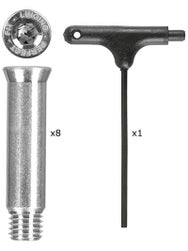
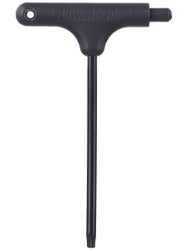
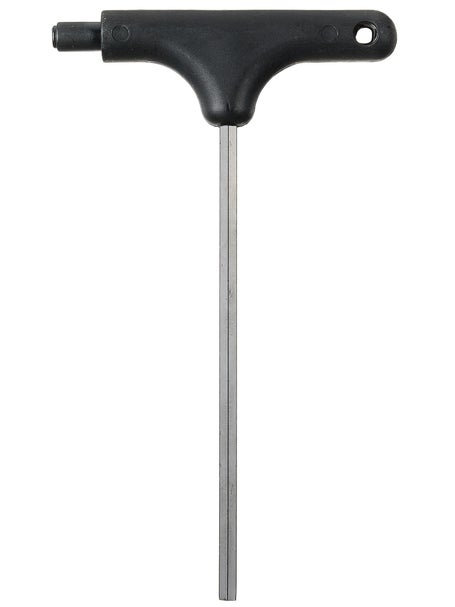
The Powerslide Hex Skate Tool is a handy-sized tool with a 4mm hex. One should always be with you when skating as you never know when you'll need it to tighten an axle or help remove/replace a wheel and/or bearing.
The size of the tool is light and easy to store and it can even be fastened to the outside of a pack using the loophole on the handle. The skinny nub on the opposite side of the handle is used to pull or push out bearings from wheels. Those with 8mm axles and floating bearing spacers can place this end of the tool in the center of the bearing and carefully work it around to pry the bearing out a little bit at a time. If using 6mm axles and long-sleeved spacers, this same part of the tool will push directly on the spacer to pop the bearing out the other side. By using this tool to remove bearings, you can prevent from damaging bearings and spacers with that screwdriver of yours.