
Overview
Playing Style
-
Power-Focused Playing Style
This style suits players who thrive on generation strong, top end speed through longer and forceful strides. They come with a stiffer boot that efficiently transfers energy into the rink for maximum power with every stride.Acceleration-Focused Playing Style
For players who rely on quick bursts of speed and agile movements to dominate the game, this type of skate is ideal. These offer a moderately stiff boot that balances support with mobility. These these skates, you can swiftly change direction, make sudden moves and accelerate rapidly.
Fit Profile
-
If multiple categories are selected, it indicates the skate is available in or can be molded to different fit profiles.
Low Profile Fit
Narrow forefoot, narrow heel pocket, shallow instep depth and low overall volume.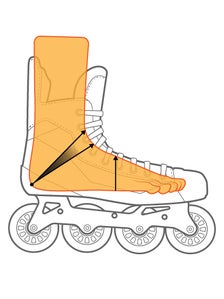
Medium Profile Fit
Medium forefoot, medium heel pocket, medium instep depth and medium overall volume.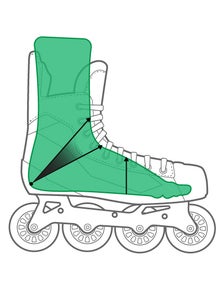
Shop All Medium Profile Skates
High Volume Fit
Wide forefoot, wide heel pocket, deep instep depth and high overall volume.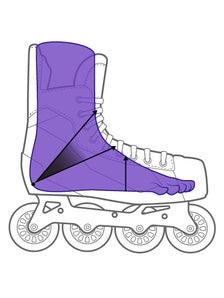
Level of Play Definitions
-
If multiple categories are selected, it indicates the skate is suitable for multiple levels of play.
Recreational-Level Skates
Built for the new-to-hockey player or casual skaters that are looking for an affordable option. These are great starter skates, especially for youth players.
Shop All Recreational Skates.Performance-Level Skates
Designed for players who are confident in their skating stride and are ready to take their performance to the next level. These players are on the rink 1-2 times a week playing mid-to-high level hockey.
Shop All Performance Skates.Elite-Level Skates
Engineered for the best performance, protection, durability and comfort. These players are usually on the rink three times or more a week and are playing high-level hockey.
Shop All Elite Skates.
Cut Protection Level
-
This is the general level of protection against cuts.
- Minimum: Basic protection suitable for competitive play
- Standard: Balanced protection for intense gameplay. Protects against more severe cuts.
- Maximum: Highest level of cut resistance for elite gameplay. Ideal for competitive adult hockey and designed for the biggest and fastest players.
ANSI Rated Cut Level
-
Measures the actual cut resistance of materials based on the ANSI/ISEA 105 standard.
ANSI Level Description Grams of Force N/A No specific cut resistance rating provided by the manufacturer. N/A A1 Minimal protection; withstands light cuts. 200-499 A2 Lower-level protection; resists slightly heavier cuts. 500-999 A3 Low-level protection; suitable for competitive play. 1,000-1,499 A4 Standard protection; defends against significant cuts. 1,500-2,199 A5 Elevated protection for intense play. 2,200-2,999 A6 Extra protection for faster, higher-impact play. 3,000-3,999 A7 Ultra-high protection. 4,000-4,999 A8 Premium protection for all levels of play and ages. 5,000-5,999 A9 Top-tier cut resistance for ultimate protection. 6,000+
Certifications
-
Indicates compliance with safety standards and regulations for hockey gear.
- USA Hockey: Approved for play under USA Hockey regulations. Ensures gear meets safety standards for organized play in the United States.
- BNQ: Certified by the Bureau de Normalisation du Quebec for cut-resistant hockey gear. Required for players in Canadian Minor Hockey leagues to ensure on-ice safety.
- CE: Meets European safety standards for protective equipment. Designed for compliance with regulations across European leagues and recreational play.
The Easton Synergy EQ50 wood blades fit tapered hockey shafts. Perfect for those players that want a traditional wood blade feel but want the responsiveness and quick shot release of a tapered hockey shaft. The EQ50 blade has replaced the SE16 wood blade.
Specifications
- Construction:
- Wood with fiberglass outer coating
- Hosel:
- High-grade hickory hosel
- Core:
- Wood core
- Weight: 145 grams (based off Hall curve)
- Fits: Low kick point hockey shafts (tapered shafts)
Previous Feedback
Comments: I originally purchased this to be put in a backup shaft to use outdoors but when my primary stick exploded I had to call that one up. For a wood blade this performs pretty well so far. I've skated with it about 7 times and it hasn't lost it's pop. I also have a Bauer APX blade and between the two I really can't tell too huge of a difference. The EQ50 has better feel for the puck but if a bit heavier which I don't particularly mind. If you don't mind the weight of this I would say it's a very solid buy!
From: Nick
Comments: I've bought a couple of this blades in Zetterberg pattern and one of them (50%) was bad in quality. Fiberglass reinforcement on one side of the hickory hosel was absent. On the other side was inappropriate installation. Where was the eyes of IW stuff then they send it to me? Now I can agree to Andrew about wear and durrability for the price, learn to bend shaft and wrist shots is ok. The main advantage of wooden blades is the possibility to play in a very cold weather where composite blades use too easily fails.
From: Nick, Kharkov, Ukraine.
Comments: I bought this to try out in roller hockey because I was breaking blades quickly (which cost too much $$). Its got a different feel as it should, I havent used a wood blade in forever so I can only compare it to composites I've used. Compared to the composites like the SE16, ST and 11k its not as stiff or responsive. So far I just use it as a back up or to play around with on wood floors. Durrability seems ok for the price, I've used it in half a game (when I broke my stick) and a dozen or more practices when I coach and it works fine. I would say if your not hard on your sticks but need a cheap blade for a tappered shaft then this will do fine. If you take a lot of slap shots and typically abuse your sticks then this might only work for a cheap back up like I use it for. It obviously will wear out quick if you play on rough surfaces. Smooth concrete is ok for wrist shots but hard slapshots will make it splinter into pieces (on concrete).
From: Andrew